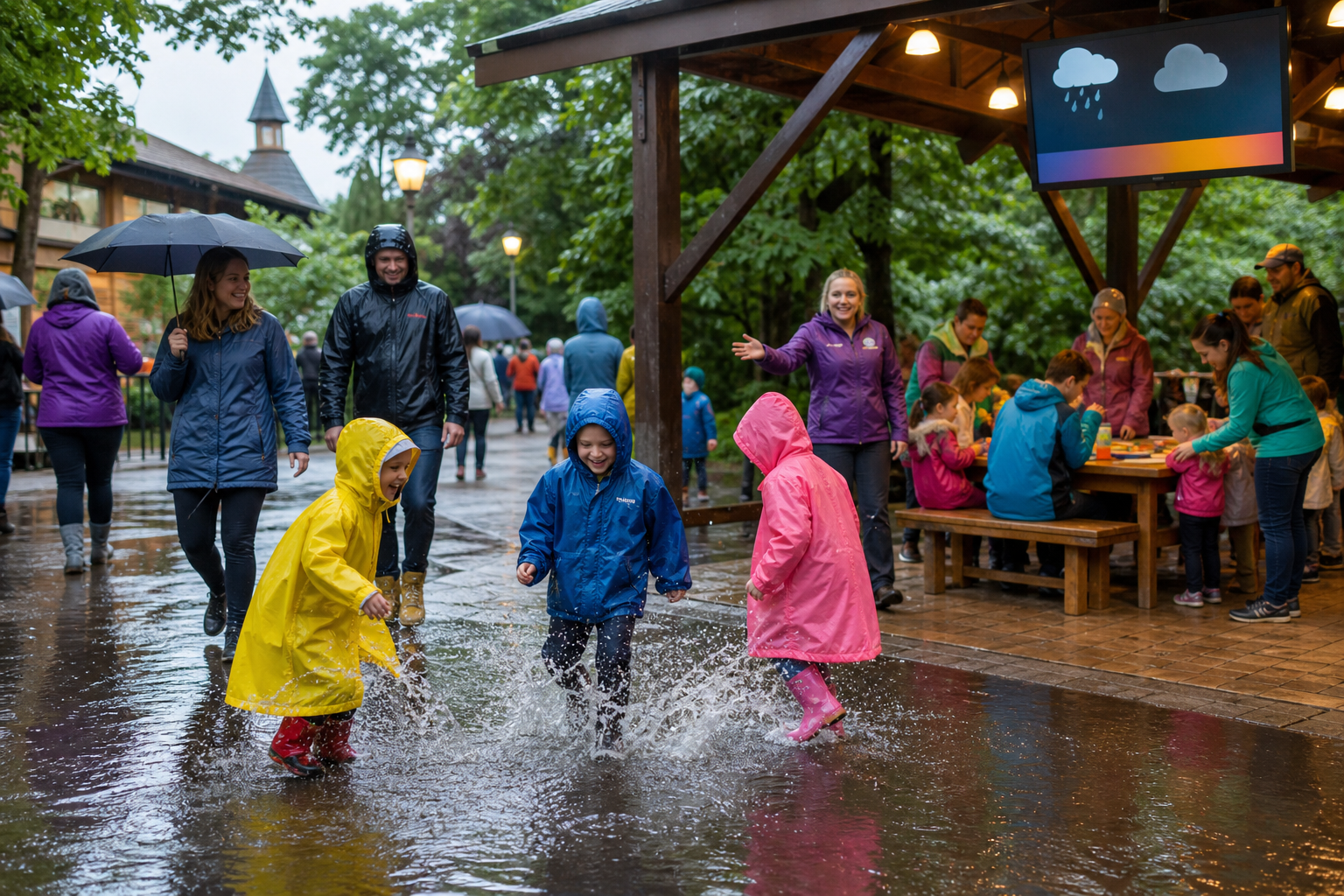
There’s an old myth tied to St Swithin’s Day (15th July) that if it rains on that day, it will continue for the next 40 days and 40 nights.
St. Swithin's day if thou dost rain
For forty days it will remain
St. Swithin's day if thou be fair
For forty days 'twill rain nae mair.
A charming piece of folklore perhaps but for visitor attractions, it taps into something far more real, the way weather still influences perception, behaviour and ultimately, ticket sales.
You may also have seen the recent conversation around the Met Office and weather forecasting, and how simplified “one icon per day” predictions can unintentionally impact visitor confidence. Because let’s be honest, if the forecast shows rain, many people simply decide not to go out at all.
But here’s the challenge. We live in Britain. Rain isn’t an exception, it’s part of the operating environment. So why does it still have the power to stop us going anywhere?
And more importantly, what can attractions do to change that?
Here’s what we think…
The real issue isn’t the weather
For many attractions, especially outdoor or mixed-experience sites, weather is still treated as a demand driver. But in reality, it’s a perception driver.
A rainy forecast doesn’t necessarily mean a poor guest experience. It often just means guests imagine it will be one.
That gap between perception and reality is where opportunity and loss happens.
So instead of asking “how do we survive bad weather?” The better question is: how do we market and design experiences that actually work in all conditions?
Pricing
Dynamic pricing is increasingly one of the most powerful tools available to attractions.
If weather is likely to suppress demand, should pricing respond to stimulate it?
A lower price point on a rainy day might feel counterintuitive but 100 guests at £15 is often far more valuable than 20 guests at £30.
It’s not about discounting but about maintaining the momentum.
Product
Some of the most successful operators actively design experiences that embrace weather rather than fight it.
That might mean expanding covered areas, creating rain-friendly programming, or even leaning into the weather as part of the experience itself.
Wicksteed Park’s “puddle jumping championship” is a great example here, turning rain from a deterrent into a feature of the visit. Genius!
When weather becomes part of the product, it loses its power to disrupt it.
Promotion
Rainy days can still be high-value visitor days especially when audiences are actively looking for things to do indoors, under cover, or differently.
Dudley Zoo famously experimented with putting live weather front and centre on its website - effectively owning the narrative instead of letting it dictate behaviour.
The most effective messaging doesn’t ignore the weather. It reframes it.
‘It’s raining - come enjoy your day anyway!’
Don’t let the bad weather dictate your day, but let it dictate your messaging.
Guarantees
One of the most effective tools in combating weather hesitation is simple: remove the fear.
Schemes like “rainy day guarantees”, where guests can return if conditions reach a certain threshold, shift the entire decision-making process.
Drayton Manor’s approach is a strong example not only adding perceived value, but reducing friction at the point of booking.
Sometimes it's not the rain itself that stops a ticket sale, but the ‘what if’ scenario that does.
So what does this all mean?
We can’t control the weather. (Although who knows maybe in the year 4050 we’ll all be living under one big bio-dome). But until then we will just have to control how we respond to it.
As Dominic Jones FRSA has said in the past:
“If you’re going to blame the weather for poor performance, you can’t take credit for good performance when the weather is bad.”
The most resilient attractions are the ones building strategies, products and messaging that work whatever the weather decides to do.